"He did a lazy sway . . . To the tune o' those Weary Blues. " --- Langston Hughes

Photo entitled "Jazz City" (NYC, 2007) by William Ellis
William Ellis's Website
William Ellis's Blog
Showing posts with label classical. Show all posts

Aug 24, 2006

Q&A: (Matthew Herbert)


To say that Londoner musician Matthew Herbert is unhappy with England's Prime Minister Tony Blair is an understatement. So it's no surprise that he channels his protests - the war in Iraq, corporate globalization, the western world's dependence on oil, to name a few - into his music that began around 2000 and includes his most recent album, “Scale.”

Herbert, a classically trained pianist, is a true darling within the electronic music world and has remixed songs by artists like REM, Björk and Serge Gainsbourg. Herbert began playing both the violin and the piano at age 4, and began singing and performing in orchestra at 7. The son of a BBC sound technician, Herbert studied theater at Exeter University and later made the 1998 work “Around the House” which is a collection of household sounds - the toaster, washing machine and a toothbrush - that he sampled and transformed into actual songs with grooves.

Sep 15, 2005

Q&A: (daKAH )


Question: What happens when you get more than 60 L.A.-based musicians playing hip-hop in the context of a classical symphony orchestra with the spontaneity of a jazz group? Answer: daKAH - a hybrid ensemble of strings, brass, woodwinds, MCs and DJs, among others.

Conceived by its conductor and primary composer Geoff Gallegos a.k.a. "Double G," daKAH and its music fuse the grooves and swing of Duke Ellington's songs, the compositional influence of Charles Mingus and Igor Stravinsky, and the dynamism of hip-hop with the wide palette of sounds common to classical instrumentation.


Not only does daKAH consist of woodwinds (alto to baritone saxophones and a bassoon), brass (trumpets and trombones), cellos, violas and violins, but also a harp, two guitars, bass, percussion, drums, keys, turntables, singers and MCs.

Jun 30, 2005

Peaks & Valleys

Like the hopeful saying goes, "Good can come from bad," and that is no exception when it comes to composing songs. Just ask pianist and songwriter Charlotte Martin, who turned her bouts of depression into picturesque musical snapshots for her debut album "On Your Shore."

"I was pretty depressed when I wrote the song 'Every Time It Rains' with label troubles and such, and my record was just shelved," she said. "A lot of the songs on the album were written on my couch where I was pretty upset."

Martin's full-length debut is now out on RCA Records and covers the emotional gamut with songs that touch upon romantic breakdowns, professional setbacks and memories of fleeting friends.

Mar 24, 2005

Q&A: (Sylvie Lewis)


Not only is British singer Sylvie Lewis an admirer of songs written by both great American and European composers, but by looking at her and listening to her music, she could have easily lived in an era (1930s through 1950s) considered the heyday for classic standards.

Lewis, who attended school in both Italy and Switzerland, recently finished work on her debut album, "Tangos and Tantrums" on Cheap Lullaby Records. It was co-produced by Lewis and musician Richard Swift.

The work - which not only makes good use of staple instruments like guitar, piano, bass and drums, but also strings, horns and a harmonica - offers up a myriad of different sounds from jazz to ragtime to cabaret to salsa.

Raised in London, Lewis became interested in European cabaret legends like Kurt Weill, Noel Coward and Lotte Lenya; and American composers like Cole Porter, Irving Berlin and George Gershwin. Lewis now resides in Los Angeles after first coming to the United States to study music at the Berklee School of Music in Boston in 1995. Lewis took a year off from school to travel in East and South Africa. In 1999, she relocated to Los Angeles where she has since become a resident musician at venues like Hotel Caf/.

The Beach Reporter this week sat down with Lewis, who speaks four languages, to talk about her earliest memories of music, the new record and her influences. Lewis will perform at Tangiers in Los Angeles April 5.

The Beach Reporter: Where do your songs off this album come from?

Sylvie Lewis: Well, I definitely think that my songs are sort of mosaics of my experiences. All sorts of things get in there like things that have happened to me, along with books that I have read, conversations that I have had with people and paintings that I have seen inspire me. So a lot of it is from my life and some of it you have to make more interesting.

Is it harder for you to talk about your own life compared to things that you haven't experienced?

The things I haven't experienced, there is always imagination, which I rely heavily on. Things from my own life, the really personal things, I need to take some time to process them and make them palatable to other people. Certain experiences I've had are too raw to talk about, so I definitely think there is a process of digesting before I can write about them in an eloquent way that will be interesting to people.

You were born in England, but went to school in Italy and Switzerland. How do you think this has shaped your exposure to music?

Well, in a funny way, I guess ... when I was in Italy I listened to a lot of Paolo Conte whom I just love. He is just brilliant, sort of like the Italian Tom Waits. I was pretty young when I went to both of those countries and not really sure that I was going to be a musician at that stage so it was more about learning languages to me. But I think that my music is very much rooted in the past - the great American songbook and also the parallel, which I think, is the great, the European songbook. Just living and growing up in Europe definitely gave me my roots in terms of European jazz.

I think in most ways learning music is just like learning a different language and because you speak a few different languages, is the learning process the same?

Yeah, I think it is. I think languages and music or playing an instrument are very similar in that if you don't practice you forget. If you don't practice guitar, you forget how to play; and if you don't speak Italian, you forget vocabulary and phrases.

You play guitar for the first time on this album. Any challenges along the way?

Yeah, it was a bit nerve-racking for me because previously I always hired people to come in and play for me because I felt like I wasn't a good enough player or technically proficient enough. But with this album, I wanted something more honest. It wasn't necessarily about being perfect. It was about being real, so I played a lot of guitar on it. It was really challenging to record anything because when you play live, the music is there and then it disappears, it's gone in the air and any mistake is gone with it. When you're recording something, you get to listen back to it over and over again; and you have to be sure that you are really happy with what you did.

Was music on the mind when you were away at school? When did the whole interest in music come about?

It started when I was about 9 or 10 years old. I was kicked out of school when I was 7 for being very misbehaved and my mother had to pick me up the day I was kicked out. She came in, dragged me down the corridor and passed all of these scowling faces of teachers. She heard a voice saying, "Mrs. Lewis, Mrs. Lewis." My mother was like, "(Bleep) it, I'm not doing this anymore, I'm not going to listen to one more complaint about my daughter, I'm not hearing it." Finally the woman who caught up with her was my piano teacher and she told her, "I just wanted to let you know that Sylvie is musically gifted and you should really pursue that with her." My mother just kissed her and walked off (laughs). So my mother enrolled me in a school where I could sing a lot in a very strong music department.

Is there a memory that stands out when you first realized the effect of music itself?

Well, I love the "Sound of Music" and when I was 5 years old I thought I wanted to be a nun because I thought nuns got to sing all the time and kiss Christopher Plummer, and that was kind of all right with me. But it wasn't too long before I realized that perhaps it is not the life of a nun and it might be another life I was looking for. I used to cycle around the park singing "Sound of Music" very loudly to all the trees and the birds, and hoping to be discovered at age 5 by Christopher Plummer. No such thing happened.

What are your top-five favorite albums?

Joni Mitchell, "Blue"

Paolo Conte, "Greatest Hits"

Rufus Wainwright, "Poses"

Richard Swift, "The Novelist"

Ute Lemper, "Berlin Cabaret Songs"

The last selection, who is that?

She is a German cabaret singer who is outrageously brilliant and beautiful, and is probably in her 40s now. She sang "Chicago" on Broadway and in London I think in the 1980s. A sixth choice, if I could have one, would be anything by Serge Gainsbourg. He's just one of my huge heroes, he's brilliant. He's a French guy who's been making albums since 1959. He's a living legend in France but no one has heard of him outside of the country.

How would you compare American composers to European composers of the 1940s and 1950s?

Well, I think in the great American songbook, the songs tend to have more of a happy ending and they also tend to be a little bit cleaner. The most ill-mannered you got was "Love for Sale" but it's not definitely about a prostitute, I mean yes it is, but it's kind of ambiguous. Whereas you have Edith Piaf singing songs about a prostitute who just murdered one of her clients. I wonder if it was because of the immediacy of war in Europe that things were not quite as nice and neat and clean. Lyrically speaking they would get dirty on you, and tell you when things were broken and messed up. I think the American tendency was to make things look beautiful. I think I fall somewhere in the middle. I want to let you know when things are messed up but I also want to make them sound beautiful to you (laughs).

Feb 26, 2004

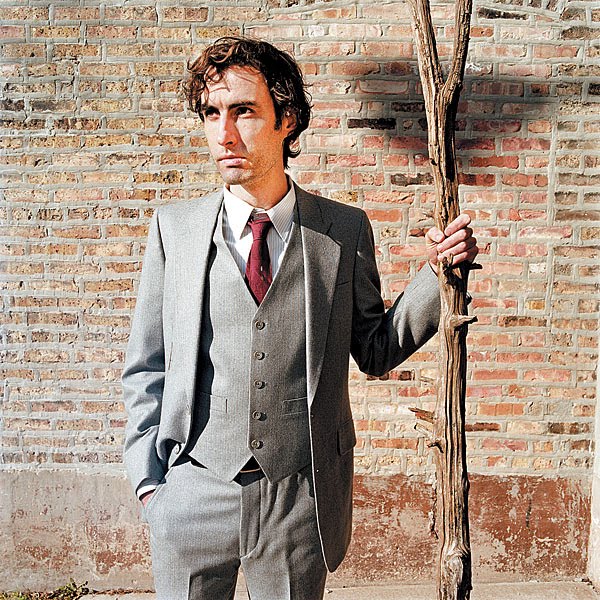
Q&A: (Andew Bird)


Signer, songwriter and violinist Andrew Bird is a musician that some would say has nearly perfect pitch.

Bird, who lives in Chicago, completed his debut record entitled "Weather Systems" that the label Righteous Babe Records, founded by singer Ani DeFranco, released in June. He spent time away from the big city, recording the work in a remote valley in western Illinois out of a barn he converted into a studio located several hours away from the bustling urban center he considers home.

He returned from a tour, promoting his 2001 work "The Swimming Hour" with his band Bowl of Fire to work on "Weather Systems."

The album comprises seven lush and layered tracks, along with Bird's musical interpretation of poet Galway Kinnell's work "First Song." Some would say Bird's vocal tone is reminiscent to that of solo artist Jeff Buckley or Radiohead's frontman Thom Yorke, which isn't too far off the mark.

The Beach Reporter recently sat down with Bird, who will return to Los Angeles March 27 at Largo, and talked about his latest work.

The Beach Reporter: The song 'First Song' you're quoting a poem by Galway Kinnell and the tone of the music really augments the story told in the poem. Was it your intention to accent the already poignant words with sonic textures that essentially complement the poem's story?

Bird: Yeah, I discovered that poem when I was 18 or 19 and I had been shuffling the words around for years trying to find the right phrasing. I knew it should be very simple but I never really made any conscious decisions about what should be on it. I always knew it should just be a guitar and vocals. I must have made 50 attempts just to get the right feel. When songs are that simple, there's really nothing to hide behind. No fancy arrangements, it's just got to be musical and so that was one of the hardest songs to record.

What about this poem did you like in particular?

I like the sound of the words. The imagery is beautiful but it was mainly the sound of the poem. His early poems have a real nice round sound to them and it kind of became a standard for my own writing. I'm not very deliberate about it. I'll get a melody in my head and then create those full sounds I need to keep that melody. Then subconsciously words begin to appear and it becomes more conscious as I work on it. For me, it has to have a nice tone so I rarely sacrifice or compromise the melody or the sound for a choice of words. Anything I need to say can't be that important. The main theme of "Weather Systems" is not so much about loneliness but more about trying to quantify things. I've been kind of obsessed with that - trying to measure the immeasurable, gaseous states like clouds or concepts like musicality, what does that mean? You can't really put a finger on it.

Speaking of loneliness, the song 'Lull' seems to be a romantic view of what it feels like to spend time with yourself.

Yeah, it's someone trying to romanticize but also realizing how ridiculous they sound.

Did you experience situations spending time with yourself that kind of inspired this idea of loneliness?

Before making this record I went out the country, fixed up and old barn, turned it into a studio and left Chicago to live in the country which was only 2-1/2 hours away. You definitely figure out what makes you happy at the end of the day because there are no distractions. Some people like to have the noise to remind themselves or the noise to not have to think about awful things. I got into a routine where I'd be out there for five to 10 days at a time, work on music for five or six hours, then go for a walk and then I'd go on tour. I just needed a change because it was starting to feel one-dimensional - touring and then coming back to a big city.

You have a great sense of pitch in your singing and whistling on the album. Because you play the violin, an instrument that kind of requires you to have a really good sense of pitch in order to play in tune, do you think that picking up and learning an instrument like the violin helped your singing?

I started doing more of the simultaneous singing and playing while doing solo shows. I guess I've been stretching my ears out for years. I think I went through a real intense period like when I was 18, 19 and 20. I learned by ear to begin with and I didn't start reading (music) until I was in high school and even then I wasn't a good reader so I would get around that by learning it by ear which went quicker for me. Now it's a bit of a curse sometimes because you can't let anything go, especially in the studio.

The song 'Skin' incorporates a wonderful balance of guitar distortions, violin and vocal lines. How structured are you with your arrangements?

Sometimes Kevin (O'Donnell, drummer) and I would do sound check and I would play some riff. We rarely jam, we are very much against jamming in theory but sometimes it's good. We just don't like to noodle too much, but sometimes at sound check you're just screwing around and I was playing this riff and Kevin would play along with me and then he'd stop and the riff would keep going. That's such a very satisfying effect that I don't have time to explore in most of my songs and "Skin" along with "I" are vignettes of full songs. It's got a lot of strong ideas that I wanted to further develop. Kevin and I have played for 10 years and he inhabits a realm that I don't: percussion. Everything else I have a pretty strong idea about - guitar, bass line, etc. - and there is a reason we've been playing together for so long.